Choosing a mobility scooter is easier when you start with the journeys you actually make. Two of the most common choices are small boot scooters and medium pavement scooters. Both can support greater independence, but they are designed around different priorities.
A boot scooter is usually selected when portability and easy transport are important. A pavement scooter is generally better suited to regular local journeys where comfort, stability and day-to-day usability matter more than fitting the scooter into a car.
At Additional Aids Mobility, customers can compare a dedicated range of small boot scooters and medium pavement scooters. This guide explains the differences to consider before choosing between them.
Boot Scooters vs Pavement Scooters at a Glance
| Consideration | Boot Scooter | Pavement Scooter |
|---|---|---|
| Best suited to | Transport, shorter trips and days out | Regular local journeys and everyday outdoor use |
| Portability | Usually the stronger choice | Generally larger and less focused on car transport |
| Storage | Often easier where space is limited | Usually needs more dedicated storage space |
| Comfort | Designed with compactness in mind | Often provides a larger seating position and more substantial ride |
| Typical decision factor | “Can I take it with me?” | “Will it suit my regular local journeys?” |
The right answer depends on the user, storage, access, transport arrangements and the distances the scooter will regularly cover. If you are unsure, an at-home or in-shop assessment can help narrow down suitable options.
What Is a Boot Mobility Scooter?
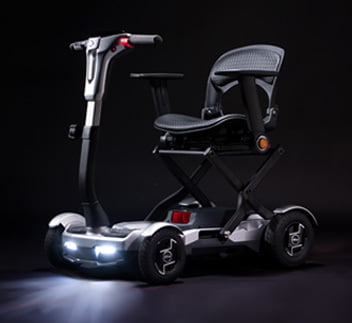
Boot scooters are the compact end of the mobility scooter range. Many are designed to be easier to transport, with components that can be dismantled or a frame that can be folded depending on the model. This makes them particularly useful for people who want to place a scooter in a suitable vehicle and use it after arriving at a destination.
The main advantage is convenience. A smaller footprint can also make storage easier at home and may be useful when manoeuvring in tighter spaces. However, compact dimensions can involve trade-offs. Seat size, suspension, ground clearance, battery capacity and overall ride characteristics vary between models, so the smallest scooter is not automatically the most suitable scooter.
If portability is your priority, browse AA Mobility’s current small boot scooter range and compare individual product specifications before making a decision.
What Is a Pavement Mobility Scooter?
Pavement scooters are intended for local mobility and regular outdoor journeys. AA Mobility’s mobility scooter guidance describes pavement models as restricted to 4mph and suitable for local journeys, shopping trips and use in pedestrian areas.
Compared with very compact boot scooters, a medium pavement scooter may provide a more substantial platform for users who plan to travel from home rather than regularly loading the scooter into a car. Depending on the model, this can mean a larger seat, more space, different tyre or suspension arrangements and a design aimed at frequent outdoor use.
You can view the current medium pavement scooter range or read AA Mobility’s broader guide to buying mobility scooters for more buying considerations.
Which Is Easier to Transport?
If you regularly travel by car and want to take a mobility scooter with you, a boot scooter will often be the first category to investigate. Before buying, check how the specific scooter folds or separates, the weight of the heaviest component, the dimensions of your vehicle’s boot and who will be lifting or loading it.
This is an important distinction. A scooter may technically fit into a vehicle but still be impractical if the user or helper cannot safely manage the components. Try the process rather than relying only on dimensions shown online.
Which Is Better for Regular Local Journeys?
For someone who mainly wants to leave home on the scooter and travel to local shops, appointments or nearby social activities, a pavement scooter may be the more natural starting point. The design is less constrained by the need to fit into a car boot, allowing the user to prioritise riding position, controls, comfort and everyday practicality.
Think about the real route: gradients, dropped kerbs, uneven surfaces, narrow entrances and storage at the destination can all matter. No single scooter type is best for every environment.
Storage and Charging at Home
Where the scooter will live is just as important as where it will travel. Ideally, plan a dry, secure and accessible storage location with enough room to move around the scooter and follow the manufacturer’s charging instructions.
A compact boot scooter may be easier to store where space is limited, while a medium pavement scooter can require a more generous storage area. Measure doors, passages and the intended storage space before buying. AA Mobility’s assessment service can help customers consider access and practical fit rather than choosing from product photographs alone.
Comfort, Controls and Confidence
Product specifications matter, but comfort is personal. Seat height, seat width, armrests, tiller position, leg room and the feel of the controls can affect whether a scooter remains comfortable and easy to use over time.
Whenever possible, test a scooter before making a final decision. AA Mobility states that customers can test-drive scooters in its showroom, which can be especially useful when comparing a compact model with a larger pavement option.
Users should also be comfortable with the rules that apply to their scooter. For further reading, see Understanding Mobility Scooter Regulations in the UK.
Questions to Ask Before Choosing
- Will the scooter mainly be used from home or transported in a vehicle?
- How far are the journeys you make most often?
- Where will the scooter be stored and charged?
- Can the user or helper comfortably manage any lifting or dismantling?
- Are there narrow doors, steep gradients or uneven surfaces on regular routes?
- Which seating position and controls feel most comfortable?
- Is there enough capacity for the user’s needs within the chosen model’s stated specifications?
Answering these questions usually makes the choice between boot scooters and pavement scooters much clearer.
Frequently Asked Questions
Are boot scooters only for occasional use?
Not necessarily. Suitability depends on the individual scooter and the user’s needs. The key difference is that boot scooters place greater emphasis on compact transport and storage.
Are pavement scooters road legal?
Pavement scooters and larger road-going scooters fall into different categories, so do not assume that every mobility scooter has the same permitted use. Check the model specification and current UK requirements before using a scooter on the road.
Can I try both types before I buy?
AA Mobility offers in-store product trials and assessments. Comparing models in person is one of the best ways to judge comfort, controls and practical size.
What if I still cannot decide?
Arrange an at-home or in-shop assessment. The aim is to match the equipment to your access, storage, lifestyle and mobility requirements rather than simply choosing the smallest or largest model.
Find the Right Mobility Scooter with AA Mobility
There is no universal winner in the boot scooter vs pavement scooter comparison. If easy transport is the priority, start with small boot scooters. If regular local journeys and a more substantial scooter are more important, compare medium pavement scooters.
For a wider overview of available options, explore AA Mobility’s mobility scooters or arrange an assessment for practical, individual guidance.